
There is a moment in every sewist’s life when a beautiful project begins to lose its sparkle.
Maybe the fabric has been sitting in your stash for two years. Maybe the pattern looked perfect online, but the finished garment does not feel like something you would reach for on a normal Tuesday. Or perhaps you made it all the way to the end, tried it on once, and quietly hung it at the back of the closet.
It is easy to assume the problem is your sewing. Often, the real issue is that the project was never a good match for your actual life.
A successful make is not only well constructed. It fits your routines, your comfort level, your wardrobe, and the way you want to spend your time. When you learn how to choose projects with those things in mind, sewing becomes more satisfying—and your handmade pieces get much more use.
Start with your real wardrobe, not your fantasy wardrobe
We all have an imaginary version of ourselves who wears dramatic sleeves, crisp white trousers, elaborate dresses, or perfectly coordinated outfits every day. That version can be a wonderful source of inspiration. She does not, however, always provide the best sewing plan.
Before choosing a pattern, look at what you already wear. Which silhouettes appear repeatedly in your laundry? Do you reach for loose layers, fitted tops, elastic-waist bottoms, or simple dresses? Which necklines feel comfortable? Which fabrics make you feel at ease?
Your answers reveal useful information about your personal uniform. If you wear the same three shapes every week, making another version of one of those shapes is not boring. It is strategic.
A handmade garment does not need to be radically different from your usual clothes to be meaningful. A familiar shape in a color, print, or fabric you love can become one of the most useful pieces in your closet.
Use the “three-outfit” test
Before cutting into fabric, imagine at least three outfits you could make with the finished piece using clothes you already own.
For a top, consider the bottoms, shoes, and layers that would work with it. For a skirt or pair of trousers, think about the tops you would actually pair with them. For a jacket, identify the garments that would fit comfortably underneath.
If you can immediately picture three combinations, the project has a strong chance of becoming a regular part of your wardrobe. If you can only imagine one highly specific outfit, pause before buying supplies. The garment may still be worth making, but you should understand that it is an occasional piece rather than an everyday one.
This test also exposes practical problems early. A beautiful fabric may not coordinate with anything you own. A cropped style may require a different proportion of tops. A statement print may need more neutral layers than your current wardrobe provides.
The goal is not to eliminate fun projects. It is to choose them with open eyes.
Match the project to your current energy
Sewing projects require different kinds of energy. Some demand careful concentration, while others are repetitive and relaxing. Some require extensive fitting, and others can be completed with minimal adjustment.
When choosing what to sew next, consider how much attention and patience you realistically have available. A complex tailored jacket may be exciting, but it may not be the right project during a busy month. A simple woven top, tote bag, or elastic-waist skirt may give you the creative satisfaction you need without creating unnecessary pressure.
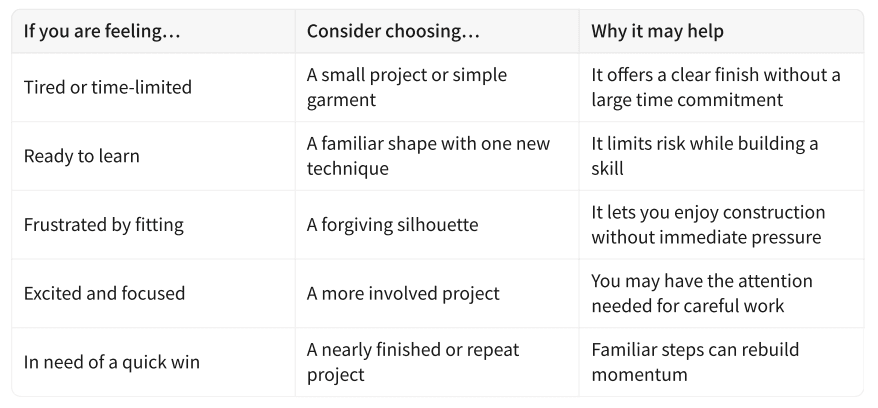
Choosing a project that matches your current capacity is not lowering your standards. It is good project management. You are more likely to finish when the work fits the season of life you are actually in.
Treat fabric selection as part of the design
A pattern and a fabric are a partnership. The same pattern can produce completely different results depending on weight, drape, stretch, texture, and print scale.
Before buying fabric, ask what you want the finished piece to do. Should it hold its shape? Move with your body? Feel cool in warm weather? Layer comfortably? Survive frequent washing?
Then compare those needs with the fabric’s behavior. A structured cotton may be excellent for a boxy shirt but too stiff for a softly gathered skirt. A fluid rayon may create beautiful movement but require more careful cutting and handling. A stable knit may be easier to wear than a woven for a close-fitting top.
If you are unsure, make a small test. Drape the fabric around your body or over a hanger. Pin a section into a rough shape. Notice whether it feels like the garment you imagined. You do not need a full mock-up to learn something useful.
The more honestly you evaluate the fabric before cutting, the fewer surprises you will encounter later.
Choose patterns that offer room to learn
A good beginner project should teach you something without asking you to solve every sewing problem at once. This principle remains useful even after you have been sewing for years.
When trying a new technique, keep other variables familiar. If you are learning to work with a slippery fabric, choose a silhouette you already understand. If you are trying a fitted pattern for the first time, use a stable fabric and a straightforward closure. If you want to practice tailoring, avoid adding an unfamiliar fabric and complicated lining at the same time.
Think of each project as having a **difficulty budget**. You can spend that budget on construction, fitting, fabric, or finishing. You do not need to make every category challenging in the same project.
This approach does not make your sewing less creative. It gives you enough control to notice what you are learning.
Make a toile when the fit matters
A toile, sometimes called a muslin, is a test version of a garment made from inexpensive fabric. It can feel like extra work, but it often saves time when fit is important or the final fabric is expensive.
You do not always need to make a complete toile. A partial version can answer a specific question. You might test the bodice to check shoulder width and neckline, the waistband to confirm fit, or one sleeve to evaluate range of motion.
Use the toile to learn about the pattern, not to create a perfect garment. Mark where the fabric pulls, gaps, twists, or restricts movement. Record the changes directly on your pattern pieces or in your project notes.
A short fitting test can prevent the much larger disappointment of finishing a garment that does not feel good to wear.
Make the project convenient to finish
A project can be perfectly chosen and still stall if the materials are scattered or one missing supply blocks progress.
Before starting, gather the pattern, fabric, thread, closures, interfacing, needles, and any specialty tools you will need. Check the instructions for supplies that are easy to overlook. A garment may be nearly complete but impossible to finish without the correct zipper, lining, elastic, or buttons.
Keep all the materials together in one container or project bag. If you must pause, leave the project with the next step written down. This turns returning to the project into a simple action rather than a reconstruction of where you stopped.
Convenience is not a minor detail. The easier a project is to resume, the more likely it is to become a finished piece.
Pay attention to the “after” plan
Before you start sewing, imagine the life of the finished object. Where will it live? How will you care for it? What will you wear or use it with? Will it need alterations after its first wash?
These questions are especially useful for garments. If a piece requires delicate cleaning, special undergarments, or constant adjustment, it may not become an everyday favorite even if it looks beautiful.
For home projects and accessories, think about function. Will the bag hold what you need? Is the cushion cover easy to remove? Is the apron comfortable enough to wear while working? A handmade object earns its place when it works well, not only when it photographs well.
Designing for use is one of the most satisfying parts of making. You are not simply producing an object. You are creating something that belongs in your life.
Let your sewing be both practical and playful
Choosing useful projects does not mean every project must be sensible. Sewing should still leave room for curiosity, experimentation, and the occasional wonderfully impractical idea.
The balance is to know which kind of project you are choosing. Some makes are wardrobe builders. Some are skill-building exercises. Some are simply an excuse to work with a fabric that makes you happy.
When you name the purpose of a project, you can evaluate it fairly. A dramatic costume does not need to become an everyday garment. A practice piece does not need to be perfect. A practical basic does not need to be exciting in the same way as a statement piece.
There is room for all of them in a creative sewing life.
Ready to choose your next project?
Open your closet and find one garment you wear constantly. Notice its shape, fabric, ease, and details. Then look for a sewing pattern that shares at least one of those qualities.
Before you cut, apply the three-outfit test, check that the fabric suits the design, and gather every supply you need. You may discover that your next favorite handmade piece is not the most complicated project in your queue. It may simply be the one that understands how you actually live.
At Sew FYI, we believe sewing should support your creativity and your everyday life. What is the most-worn item in your closet—and how would you make your own version of it?