
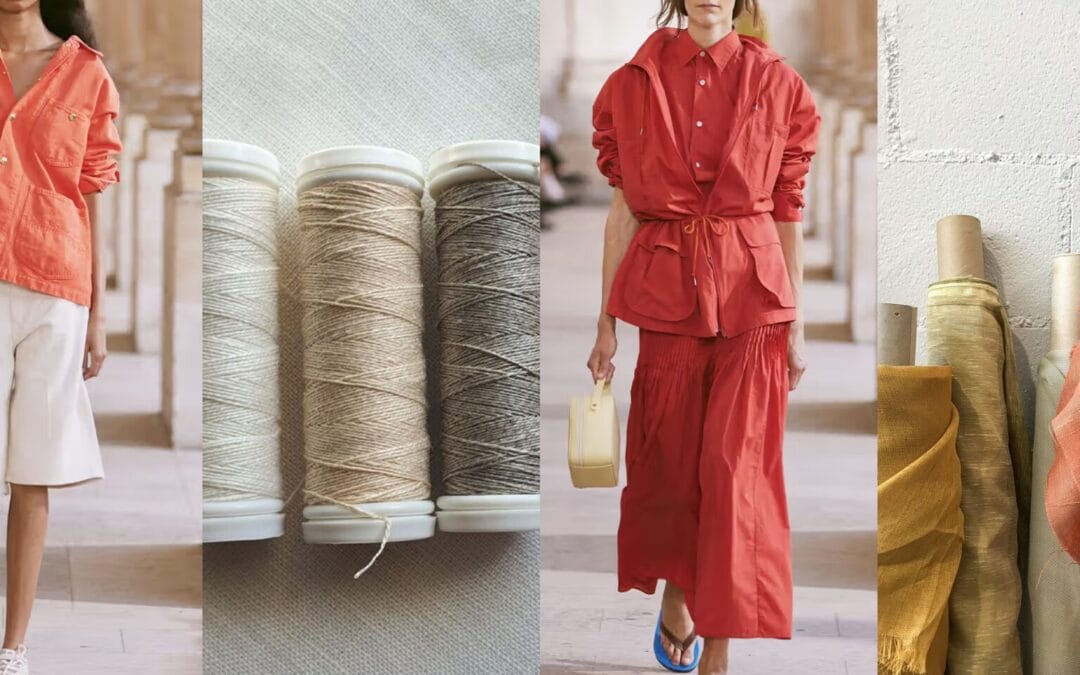
Every season, we love watching the runway shows — not to copy them wholesale, but to extract the wearable ideas hiding inside the spectacle. SS2026 is full of moments that translate beautifully to home sewing, and honestly? This season felt like it was made for makers. The silhouettes are relaxed, the details are tactile, and the fabrics are the kind you actually want to work with. Here’s our edit of what’s actually worth making — and how to make it yours.
Trend 1: The Relaxed Linen Co-ord
Easy separates in natural linen — wide-leg trousers paired with a boxy camp collar shirt — dominated several major shows this season. For home sewers, this is an excellent entry point: linen is forgiving to cut, presses beautifully, and the relaxed fit means less precise fitting. Look for patterns with minimal ease and dropped shoulders. The real magic of this trend is in the fabric choice — undyed, stone-washed, or naturally dyed linens all read as intentional and elevated. If you want to go the extra mile, sewing your top and trousers from the same fabric cut transforms two simple garments into a proper set. Bonus: they work just as well worn separately.
Trend 2: Contrast Stitching as a Design Statement
Topstitching shifted from a construction detail to a focal point this season. Think visible contrast thread in a bold color — rust on cream, black on butter yellow, forest green on camel — running along every seam. This is a free upgrade for any project already in progress and a great way to practice your straight-stitch control. The key is committing to it: go bold with your thread color, use a slightly longer stitch length (3.0–3.5mm reads as intentional), and stitch consistently close to the seam. A wobbly topstitch done in matching thread looks like a mistake. A wobbly topstitch in a contrasting color looks like personality. Lean in.
Trend 3: The Bias-Cut Midi Slip Dress
The bias slip dress never fully disappears, but SS2026 brought it back in a more wearable, everyday weight — charmeuse and lightweight satin blends rather than full silk. Sewing on the bias is an intermediate-level challenge (the fabric shifts while cutting and sewing) but the result is one of the most stunning garments you can make. A few tips before you start: let your cut fabric hang on the dress form or a hanger for 24 hours before sewing to allow the bias to relax and stretch, use plenty of pins or clips, and sew slowly. The effort pays off every single time you put it on.
Trend 4: Utilitarian Pockets, Everywhere
Deep functional pockets appeared on dresses, skirts, and even tailored blouses this season — and they weren’t subtle about it. We’re talking wide patch pockets, exposed welt pockets, cargo-style flap pockets stitched in contrast thread (see Trend 2). For home sewers, this is a wonderful trend because pockets are infinitely customizable. Adding a welt pocket or a patch pocket with contrast stitching to an otherwise simple pattern elevates it enormously. Can’t find a pattern with the pocket placement you want? Move it. Scale it up. Make it the whole point. That’s the beauty of sewing your own clothes — the details belong to you.
Trend 5: Sculptural Shirring and Ruching
One quieter trend worth noting: gathered and ruched panels appearing as deliberate structural moments rather than just filler detail. On the runway this looked like shirred back bodices, ruched side seams, and elasticated waist channels on otherwise clean silhouettes. For sewers, this is an approachable technique with a high visual payoff — a few rows of elastic thread in your bobbin transforms a flat panel into something textured and interesting. Try it on a sleeve, a back yoke, or a waistband before committing to an entire bodice.
Build your SS2026 capsule at Sew FYI
Ready to sew your SS2026 wardrobe? Check our YouTube Channel for FREE tutorials or join our Sewing Series workshop — we’d love to sew alongside you this season.
